
A brilliant, peer-reviewed patent fails rapidly in the competitive enterprise ecosystem if the initial public digital interface looks unvetted. Many engineering teams, clinical pioneers, and hard-tech innovators focus their resources exclusively on refining internal technical mechanics while treating public web infrastructure as an afterthought. Generalist creative agencies build exceptional digital storefronts for consumer retail brands, but they fundamentally lack the deep technical literacy required to engage cynical corporate compliance officers or global venture capitalists.
Elite scientific founders treat their single-product website design as a primary commercialization engine. Institutional stakeholders do not audit early-stage proprietary technology via standard consumer retail signals. Instead, they demand instant digital validation, structured information access control, and absolute risk mitigation. To secure transformational seven-figure investment rounds or long-term enterprise licensing partnerships, a digital ecosystem must achieve a deliberate, defensible equilibrium between market validation and rigorous intellectual property security.
Why does generalist web development fail technical innovators?
The core structural flaw of commodity content management systems and standard e-commerce templates stems directly from their default transactional orientation. Standard business layouts prioritize immediate, high-volume transactional processing, rapid retail checkout flows, and flash-in-the-pan consumer engagement hooks. This standard consumer framework completely lacks the sophisticated spatial configuration necessary to cleanly organize complex regulatory documentation, validation records, or extensive clinical study timelines.
Furthermore, standard creative design frameworks ignore the specific data privacy protocols required during advanced corporate due diligence cycles. When an unoptimized site relies heavily on tracking scripts or insecure server scripts, it risks exposing pre-launch research pipelines to aggressive automated parsing bots. This operational gap exposes vital scientific assets before international global protections have been legally finalized.

How do you protect intellectual property on a public landing page?
The solution requires transitioning to a highly structured framework known as Macro-Utility Web Architecture. This custom layout system displays the concrete, real-world macroeconomic problem an asset solves without exposing internal schematics, codebases, or proprietary manufacturing steps. Your public interface highlights the definitive operational consequence of the innovation rather than exposing the underlying mechanical blueprint to competitors.
Replacing dense engineering diagrams with interactive "Input versus Output" performance graphics allows engineering evaluators to verify system efficiency safely. For instance, rather than mapping an entire proprietary chemical or electrical formula openly, interactive UI elements allow partners to toggle custom input values and instantly witness simulated yield results, keeping the underlying algorithmic logic entirely masked behind server-side barriers.
Data Presentation Matrix: Technical Visual Layouts
| Architecture Element | Academic Paper Layout (Avoid) | Progressive Disclosure Framework (Use) |
|---|---|---|
| Hero Infrastructure | Complex, abstract chemical or engineering nomenclature paired with heavy paragraphs. | A singular, definitive macroeconomic value statement outlining industrial scale and economic impact. |
| Empirical Validation | Raw laboratory data logs and low-resolution unedited diagnostic charts. | Polished interactive charts, reactive simulated data sliders, and abstract WebGL geometry. |
| Call to Action Flow | Unmonitored generic text email links lacking secure intake pipelines or validation fields. | Secured, multi-tier intake authentication gateways connected directly to strict compliance validation workflows. |
What interface architecture converts a skeptical enterprise buyer?
Cynical enterprise procurement directors, chief technology officers, and institutional research leads consistently deploy defensive, hyper-critical scanning behaviors when evaluating unproven proprietary technology. They are biologically conditioned to look for flaws, exaggerations, or unverified claims that signal institutional risk. To systematically dismantle this native skepticism, your user interface must deploy a disciplined Progressive Disclosure Framework. This methodology balances deep technical granularity with modern cognitive design principles, deliberately structuring the complexity of your data assets based entirely on the user's vertical scroll position.
The structural error most academic founders make is treating their public homepage like an unstructured academic dumping ground. This creates instant cognitive overload for economic buyers who need to understand the macroeconomic value first. Conversely, standard marketing agencies oversimplify the asset, stripping away the raw empirical validation that technical gatekeepers require to grant a formal discovery meeting.
Progressive Disclosure Validation Hierarchy
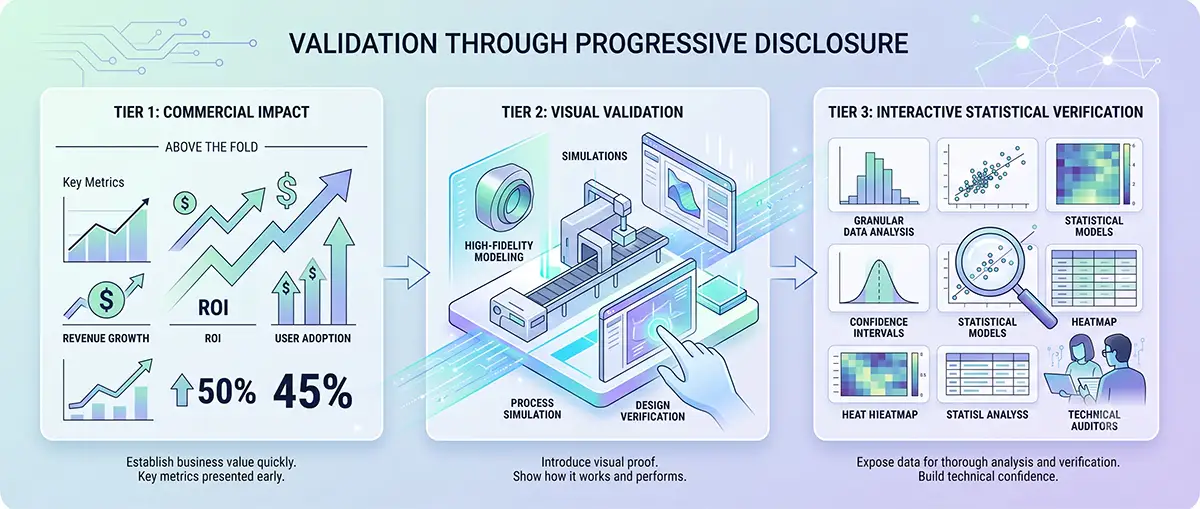
The 3-Tier Layering Mechanics
Progressive disclosure splits your validation into hierarchical tiers: Tier 1 establishes commercial impact above the fold; Tier 2 introduces visual validation via high-fidelity modeling or process simulations; Tier 3 exposes the interactive statistical verification layers required by technical auditors.
Tier 1: Commercial Impact
Establishes key commercial outcomes above the fold (ROI, revenue, market share) for quick business stakeholder validation and immediate investor trust.
Tier 2: Visual Validation
Introduces visual proof via high-fidelity product modeling and realistic process simulations to confirm functionality without exposing proprietary schematics.
Tier 3: Statistical Verification
Exposes the complex, interactive statistical analysis layers and granular data grids required for technical auditor verification and deep-dive due diligence.
Instead of embedding unoptimized, low-resolution static PDF documents that break the mobile viewing experience and disrupt analytical engagement, you must translate your core laboratory testing metrics into high-performance, responsive data layers. Utilizing standardized semantic HTML markup ensures that your proprietary validation datasets, patent-pending citations, and international regulatory compliance milestones remain completely scannable by both human eyes and automated semantic AI search indexers.
By engineering an interface that allows an enterprise evaluator to organically drill down into independent variables, you shifts the buyer dynamic from passive reading to active, empirical discovery. When a user can safely manipulate a data visualization model on your page to mirror their specific industrial operational parameters, they validate your product’s economic viability in real-time, drastically reducing the friction of your enterprise sales cycle.
Why must you build a secure investor data room into your domain?
Relying on external file shares or third-party links during critical funding rounds disrupts brand authority and introduces dangerous, unmonitored security footprints. Hosting a pristine, encrypted investor data room directly within your native root domain projects corporate institutional maturity and protects files during late-stage valuation discussions.
By implementing automated, legal-grade non-disclosure workflows directly at the server gateway, you require rigorous identity verification prior to revealing whitepapers or clinical trial details. This custom setup provides technical founders with granular analytical intelligence, allowing you to log exactly when and where venture capital partners or enterprise licensees evaluate your proprietary assets.
Institutional & Technical Verification
Frequently examined parameters concerning single-asset web engineering.
Deploy strict Macro-Utility modeling parameters. Your system architectures must focus intently on clear high-level inputs and macro performance outputs rather than revealing internal structural compositions. All deep algorithmic logic should be processed completely behind server-side barriers to ensure your intellectual property remains secure while demonstrating value to investors.
Custom headless software environments or meticulously engineered framework servers represent the premier standard. This setup ensures adequate performance budgets for WebGL components, processes live client data rooms smoothly, and remains isolated from common malicious target points. Lady Lake Web Design specializes in these high-performance architectures for Florida entrepreneurs.
Venture capitalists use the public platform to instantly evaluate market positioning and verification standards. Once basic credibility is established via your digital showcase, they transition seamlessly through authorized secure gateways into root-hosted data rooms for automated legal due diligence. This streamlined flow is essential for securing Florida venture capital.