LOCAL SEO • GOOGLE AI • SMALL BUSINESS
The Local SEO Paradigm Shift: From Google to AI Agents
Yellow Pages changed how people found local businesses. Google changed how they searched. AI agents are beginning to change how they choose.
Written for Florida small businesses, including Lady Lake, The Villages, Leesburg, Tavares, Eustis, Mount Dora, and nearby Central Florida markets.
Quick Answer
Local SEO is entering a new paradigm.
Customers once used the Yellow Pages to find businesses, then Google to search, compare, and choose among them. Now AI-powered search and agents are beginning to help people research options, compare businesses, and take the next step. For Florida small businesses, the goal is shifting from simply ranking for keywords to being clearly understood, locally relevant, trusted, and easy for Google and AI systems to recommend.
There was a time when finding a local business meant reaching for a thick yellow book.
You looked up “electricians,” “restaurants,” “lawyers,” “dog grooming companies,” or another category, scanned the listings, and started making phone calls.
Then Google changed everything.
Instead of flipping through pages of businesses, customers typed a few words into a search box. Google sorted through an enormous amount of information and presented what it believed were the best answers.
That shift created the modern SEO industry.
Businesses learned how to build websites, target search phrases, earn links, manage Google Business Profiles, collect reviews, and compete for those valuable positions near the top of Google's results.
Now another shift is underway.
The question is no longer only:
“Where can I find a business that does this?”
Increasingly, people can ask:
“Which business should I choose?”
That is the real significance of the move toward AI-powered search and AI agents.
Google's 2026 announcements make the direction clear. Google says AI Mode has become a deeper conversational search experience, while new Search agents can work across information on the web and agentic capabilities are expanding into local services and bookings.
This is bigger than another Google algorithm update.
It is a paradigm shift in local search.
And for a small business in Lady Lake, Leesburg, Tavares, Mount Dora, The Villages, Lake County, or elsewhere in Central Florida, that shift raises a very practical question:
Will your business be easy for an AI system to understand well enough to recommend?
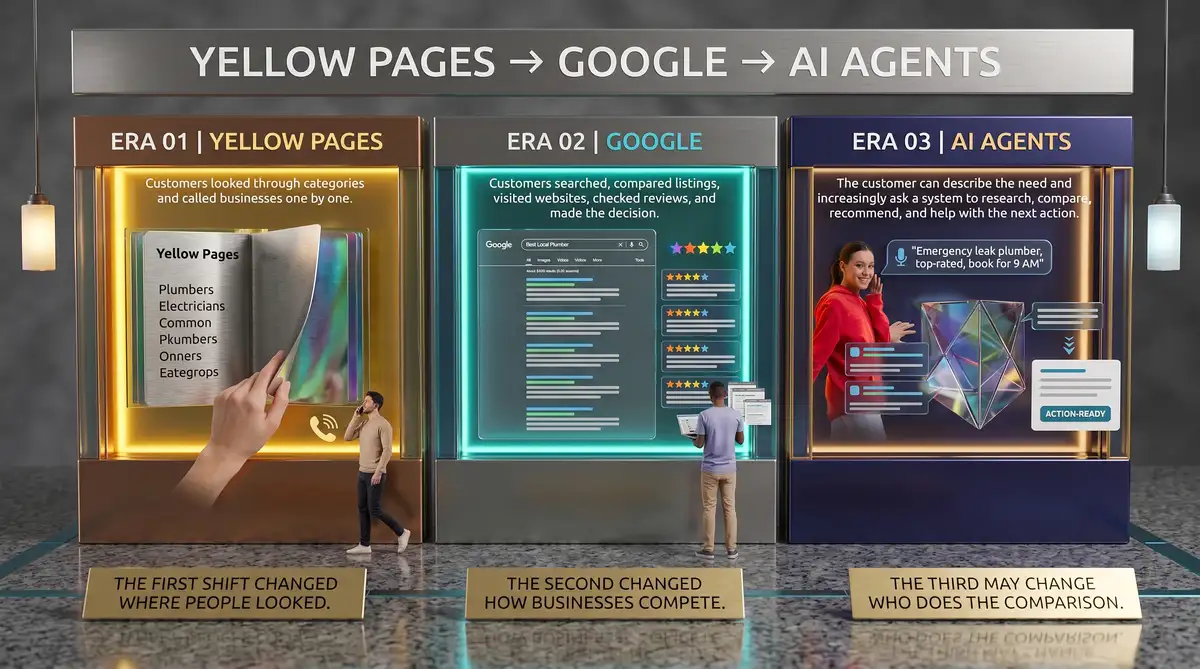
THE THREE SEARCH ERAS
Yellow Pages → Google → AI Agents
Three different ways customers can find and choose a local business.
Era 01
Yellow Pages
Customers looked through categories and called businesses one by one.
Era 02
Customers searched, compared listings, visited websites, checked reviews, and made the decision.
Era 03
AI Agents
The customer can describe the need and increasingly ask a system to research, compare, recommend, and help with the next action.
The first shift changed where people looked.
The second changed how businesses competed.
The third may change who does the comparison.
THE BIGGER CHANGE
Why Is Local Search Entering a New Paradigm?
The simplest way to understand the change is to look at how the customer's behavior has changed.
A traditional Google search might look like:
Traditional search
“Best fence company in Lady Lake FL”
The customer then reviews several listings, visits websites, looks at photos, reads reviews, and calls a few companies.
An AI-assisted search could look more like:
Conversational search
“Find three reputable fence companies near Lady Lake that install vinyl fencing, have strong reviews, serve my area, and can schedule an estimate soon.”
That is a different kind of search.
The customer has supplied a goal, not simply a keyword.
Google's current AI Search documentation says AI Overviews and AI Mode can handle more complex questions, comparisons, and follow-up exploration. Google also explains that these systems may issue multiple related searches across different subtopics and sources to build a response.
The practical implication for local businesses is straightforward:
Your business information has to make sense beyond one keyword.
Google and emerging AI systems need to understand what you do, where you do it, what makes you credible, and whether your business fits the customer's specific request.
GOOGLE IN 2026
What Has Google Actually Changed in 2026?
There has been plenty of discussion about “the latest Google algorithm update,” but the bigger story is not a single update with a catchy name.
Google's published ranking history shows several significant ranking changes in 2026, including a March core update, a March spam update, a May core update, and a June spam update. The May 2026 core update ran from May 21 through June 2, while the June 2026 spam update ran from June 24 through June 26.
Ranking systems continue to evolve
Core and spam updates still matter. Traditional SEO is not disappearing.
The search experience is changing
AI Overviews, AI Mode, and agentic features are changing how information can be found and used.
Google's current documentation says the same foundational SEO practices remain relevant for AI Overviews and AI Mode. A page still needs to meet normal Search technical requirements, be indexable, and provide useful, reliable, people-first information.
Google also published a 2026 resource focused specifically on generative AI Search. The guidance emphasizes valuable, unique, non-commodity content, local information, and the continued importance of standard SEO practices.
Important distinction
The answer is not “throw out SEO and start doing AI SEO.” The stronger move is to build a better business presence that both people and search systems can understand.
LOCAL ADVANTAGE
Why Does This Matter So Much for Local Florida Businesses?
Local businesses have one major advantage over national companies:
They know something about a place.
A national article can explain what a fence is.
A local fence contractor can explain what homeowners around Lake County actually ask about when they are choosing between wood, vinyl, aluminum, and chain link.
A national website can say that roof inspections are important.
A local roofing company can explain the problems customers routinely see after Florida weather, what a proper inspection covers, and what homeowners should ask before signing a contract.
The local advantage
- First-hand experience
- Local customer questions
- Real project examples
- Regional knowledge
- Community reputation
- Original photographs and evidence
That first-hand knowledge has value.
Google has emphasized original, useful information rather than generic content produced only to attract search traffic. Its 2026 guidance specifically calls for valuable, unique, non-commodity content and points site owners toward useful local information.
That creates an opportunity.
The more your website sounds like a real business with real experience, the more useful it becomes to customers and the more information exists for search systems to interpret.
Think about a homeowner in Lady Lake.
They are not really looking for the phrase “vinyl fence installation Lady Lake Florida.”
That is only a compressed version of what they actually want.
They want a contractor who understands the job, serves their area, shows real examples, communicates clearly, provides a fair estimate, and finishes the project properly.
The search phrase is only the surface.
The business decision underneath it is much larger.
LOCAL RANKING SIGNALS
How Does Google Know Whether a Local Business Fits a Search?
Google says local search results are primarily influenced by relevance, distance, and prominence.
01
Relevance
How closely your business matches what the person searched for.
02
Distance
The relationship between the searcher and your business location or service area.
03
Prominence
How well-known and established your business appears across the web.
That is useful because it explains why local SEO has never been just about putting a city name on a page.
A business can improve its local presence by making its information more complete and accurate.
- Correct business category
- Accurate hours
- Accurate contact information
- Services
- Photographs
- Business description
- Service areas
- Customer reviews
- Useful website information
Google specifically recommends complete and detailed Business Profile information so it can better understand a business and match it to relevant searches.
Now take that same idea one step further.
If AI systems are being asked to compare businesses for a customer, the quality and clarity of business information becomes even more important.
Imagine an AI assistant trying to answer:
“Which HVAC companies near Leesburg serve older homes and offer emergency service?”
A vague website makes that difficult.
A well-organized site that clearly states services, service areas, hours, emergency availability, customer experience, credentials, and real examples gives the system much more useful information.
Clear information gives search systems something to work with.
CONTENT QUALITY
Why Are SEO Experts Putting More Emphasis on Original Business Experience?
For years, many businesses approached blogging as a production exercise.
Pick a keyword
Write an article
Publish and repeat
That approach becomes weaker when hundreds of businesses publish nearly identical content.
AI makes that problem even larger because generic content can now be produced at tremendous speed.
That means the competitive value of generic information keeps dropping.
What remains valuable? Things that are specific to the business and difficult to copy without actually doing the work.
Generic
“Regular fence maintenance can extend the life of your fence.”
Business-specific
“We routinely see fence posts around Lake County that fail because water has worked its way around poorly compacted soil. During an inspection, we look at the post depth, movement, gate alignment, and signs of moisture damage before recommending a repair.”
The second statement gives a potential customer something useful.
It also sounds like someone who has actually stood in a customer's yard.
That is the type of content local businesses should create more often.
Publish more of this
- Real project examples
- Real customer questions
- Real photographs
- Real comparisons
- Real service explanations
- Real pricing factors
- Real local conditions
- Real lessons from completed work
Your business already owns this information. The challenge is putting it into a form that customers and search systems can understand.
AI-READY LOCAL SEO
What Does “AI-Ready Local SEO” Actually Mean?
Forget the technical label for a moment.
An AI-ready local business is simply a business that is easy to understand and easy to trust.
Question 01
Who are you?
The company, people, brand, experience, and credentials.
Question 02
What do you do?
The services, products, specialties, and problems you solve.
Question 03
Where do you work?
Your location, service area, and communities you actually serve.
Question 04
Why should I trust you?
Reviews, experience, credentials, photos, examples, guarantees, and proof.
Your website, Google Business Profile, reviews, photographs, social profiles, directory listings, and other legitimate online references should reinforce those answers.
For example, a Central Florida fence contractor might clearly state:
“Locally owned fence contractor serving Lady Lake, The Villages, Leesburg, Fruitland Park, Tavares, and surrounding Lake County communities.”
Then each major service can have its own useful page:
The purpose is not to create hundreds of thin pages. The purpose is to make the business easier to understand.
IMMEDIATE ACTIONS
What Should a Florida Small Business Change Right Now?
You do not need to rebuild everything tomorrow. Start with the information customers and Google already see.
Clean Up Your Google Business Profile
Review your primary category, secondary categories, business description, hours, phone, website, services, photographs, service area, and customer reviews.
Complete and accurate information gives Google better context about your business.
Make Your Main Services Easy to Understand
Build useful service pages that explain what the service includes, who needs it, options, process, pricing factors, timing, coverage area, warranty information, and how to get started.
Show the Work
Use photographs of real projects, employees, equipment, completed work, storefronts, service vehicles, and approved before-and-after examples.
Make Reviews More Informative
Encourage satisfied customers to describe the service they actually received. Genuine details provide more useful context than a one-line compliment.
Make Your Local Coverage Clear
Explain where you really work. Use useful local information rather than repeating city names across nearly identical pages.
Add Original Business Knowledge
Publish actual customer questions, project lessons, local conditions, comparisons, first-hand advice, and examples that come from doing the work.
THE MINDSET CHANGE
What Is the Difference Between Traditional SEO and the New Local Search Model?
The difference can be summarized in one question.
Traditional SEO asks:
“How do I rank for this search?”
The emerging model asks:
“How do I become a strong answer for this customer's need?”
| Traditional SEO Thinking | Paradigm-Shift Thinking |
|---|---|
| Target a keyword | Understand a customer need |
| Rank a page | Become a trusted business option |
| Add city names | Demonstrate genuine local relevance |
| Publish frequently | Publish useful original information |
| Chase rankings | Track qualified leads and visibility |
| Optimize only the website | Build a consistent business presence |
| Think about Google results | Think about Google, Maps, AI and customers |
| Get traffic | Earn consideration |
This does not mean rankings no longer matter.
They do. Google explicitly says foundational SEO remains relevant for AI features, and pages still need to be eligible for normal Google Search to be eligible as supporting links in AI Overviews or AI Mode.
The shift is in what that visibility is ultimately serving.
REPUTATION
Why Reviews, Reputation and Local Mentions Matter More Than Ever
A customer deciding between businesses wants evidence.
AI systems need evidence too.
Google's local-ranking guidance says prominence includes information Google has about a business from across the web, and that reviews and positive ratings can contribute to local ranking.
A weak review
“Great company!”
A descriptive review
“They replaced the old wood fence around our Lady Lake home, rebuilt the gate, cleaned up the yard, and finished on schedule.”
You should never write fake reviews or pressure customers to make false statements.
But you can make it easy for satisfied customers to describe the service they actually received.
Their genuine language can also reveal the topics customers care about. Those customer phrases can help you improve service pages, FAQs, and future content.
The objective is not to collect hundreds of low-quality directory links. The objective is to build a real reputation.
A business that is genuinely known in its community has something valuable that cannot be manufactured overnight with an SEO tool.
AI + CONTENT
What About AI-Generated Website Content?
AI can help you write. It cannot replace your business experience.
Use AI to help organize customer questions, create outlines, edit wording, identify gaps, or turn notes into a clean article.
But give it the real material.
Then edit the final content so it accurately represents the business.
Google's guidance does not tell businesses to add a special “AI SEO” layer to their websites. Instead, it continues to emphasize useful, unique, people-first content and standard SEO fundamentals.
You do not need to beat AI at producing more words. You need to provide information that AI cannot get from every other generic website.
THE NEXT STEP
How Will AI Agents Change Local Search?
This may be the most significant part of the shift.
Google announced in May 2026 that its Search direction includes agents that can work across information on the web, and it expanded agentic booking capabilities to local services and experiences.
Imagine the difference.
Old search
“Fence companies in Lady Lake.”
New search
“Find a well-reviewed fence company near Lady Lake that installs vinyl fencing, serves my neighborhood, can provide an estimate, and has availability this month.”
The second request contains a goal.
An agent can potentially handle more of the research process instead of merely returning ten blue links.
That does not mean every local customer will suddenly stop visiting websites.
It means the website may increasingly become one of the information sources used during the decision.
Google's AI systems can use query fan-out, meaning they may perform multiple related searches across different parts of a question before producing a response.
That makes clarity more valuable.
Service
What do you actually do?
Location
Where do you actually work?
Qualifications
Why should someone trust you?
Evidence
What proves you do good work?
Availability
Can the customer realistically hire you?
Contact
How does the customer move forward?
CENTRAL FLORIDA
What Does This Paradigm Shift Mean for Lady Lake and Central Florida?
The strongest local SEO strategy starts with the places your business genuinely serves.
Lady Lake
Local services, businesses, homeowners, and neighborhood-level search intent.
Lake County
Broader service coverage across communities and regional customer needs.
The Villages
A major local service market where reputation, proximity, and clarity matter.
Central Florida
A larger regional market for businesses serving multiple communities.
For businesses serving Central Florida, location relevance should appear naturally in the website, service pages, reviews, project examples, and Business Profile.
Nearby communities may include Leesburg, Tavares, Eustis, Mount Dora, Fruitland Park, Wildwood, Clermont, and others where the business actually works.
Local SEO reminder
Use locations where the business genuinely works. Add useful local information instead of simply swapping city names across nearly identical pages.
90-DAY ACTION PLAN
What Should a Florida Small Business Do Over the Next 90 Days?
You do not need a giant technology project. A focused 90-day effort can make a meaningful difference.
Days 1–30
Get the Foundation Right
- Google Business Profile
- Business categories
- Hours, phone and website
- Service area
- Main service pages
- Customer reviews
- Real photographs
Days 31–60
Add Real Business Knowledge
- Service content
- FAQs
- Project stories
- Before-and-after examples
- Comparison guides
- Local service information
- Company and team information
Days 61–90
Test the New Search Experience
- Ask real customer questions
- Check AI answers
- See which competitors appear
- Find missing information
- Correct unclear service descriptions
- Review important online mentions
- Measure leads and calls
MEASUREMENT
How Should a Business Measure Success?
Rankings still matter, but they are not the entire story.
For a local business, track calls, clicks, direction requests, form submissions, organic traffic, branded searches, service-related searches, leads, booked appointments, and qualified inquiries.
Google also introduced Search Console reporting for visibility in generative AI features during June 2026, including visibility from AI Overviews and AI Mode.
Watch these signals
The measurement model is moving from “Where did I rank?” toward “How often is my business surfaced when people ask for the type of service I provide?”
LOOKING AHEAD
What Should Florida Small Businesses Expect Next?
The exact form of AI search will continue to change. No honest SEO professional can tell you exactly what every AI system will do next year.
But the direction is becoming easier to see.
- Search is becoming more conversational.
- Search is becoming more personalized.
- Search is becoming more capable of comparing information.
- Search is beginning to take actions on behalf of users.
- Local services are becoming part of that process.
That means businesses should prepare for customers to ask more complete questions.
Instead of
“Dentist Lady Lake.”
A basic category search.
Ask for a fit
“Find a highly rated dentist near Lady Lake that accepts new patients.”
The business must show
Services, location, reputation, availability and trust.
The businesses that explain themselves clearly will have more information available when those questions are asked.
THE REAL TAKEAWAY
The Local SEO Paradigm Shift Is Really a Trust Shift
This is the part small businesses should remember.
The technology will keep changing.
Google's interface will change. AI models will change. Search features will change.
The underlying customer decision will not.
People want to hire someone they believe can solve their problem.
That is why the strongest response to the AI Search era is not to chase every new SEO acronym.
It is to build a stronger business presence.
Google's own guidance continues to point businesses toward the fundamentals: useful content, strong technical foundations, local information, and information that genuinely serves people.
Be found.
Be understood.
Be trusted.
Be recommended.
COMMON QUESTIONS
Frequently Asked Questions About the Local SEO Paradigm Shift
Plain-English answers for Florida small business owners.
What is the local SEO paradigm shift?
The local SEO paradigm shift is the move from customers simply searching for businesses toward search systems helping customers research, compare, and choose businesses. The Yellow Pages organized businesses into categories. Google organized information around searches and rankings. AI-powered Search is increasingly able to understand complex requests and help with recommendations and actions.
Will AI agents replace Google Search for local businesses?
AI agents are becoming part of Google Search rather than replacing Search outright. Google has announced more conversational AI Search features and agentic capabilities for tasks that involve research, comparison, and local services. Traditional Search, Maps, websites, and Business Profiles remain part of the broader ecosystem.
Does SEO still matter with Google AI Overviews and AI Mode?
Yes. Google says the same foundational SEO practices remain relevant to AI Overviews and AI Mode. Pages still need to meet Google's technical requirements, be indexable, and provide helpful, reliable, people-first content. Google does not require a separate secret form of “AI SEO.”
How can a local business appear in AI search results?
Start with the fundamentals: make the website technically accessible, clearly explain services and locations, publish useful original information, maintain an accurate Google Business Profile, build a strong reputation, and provide real evidence of the company's work. Google says foundational SEO practices remain the basis for appearing in its AI Search experiences.
Does Google Business Profile still matter in 2026?
Yes. Google continues to state that local rankings are primarily based on relevance, distance, and prominence. Complete and detailed Business Profile information helps Google understand what a business does and match it with relevant local searches.
Should small businesses stop writing blog posts because of AI?
No. The better approach is to stop treating blog publishing as a race to produce the most generic articles. Publish material based on real customer questions, first-hand experience, local conditions, projects, comparisons, and practical advice. Google has emphasized valuable, unique, non-commodity content in its guidance for generative AI Search.
What should a Lady Lake business do first?
Start with the basics: verify the Google Business Profile, correct categories and business information, review the service area, strengthen the main service pages, add real photographs, collect genuine customer reviews, and make the company's local expertise clear on the website.
Will AI recommend the cheapest local business?
There is no published Google rule saying AI will simply recommend the lowest-priced business. Local search already considers factors such as relevance, distance, and prominence, while AI Search can consider a more complex request and supporting information. A business should therefore provide clear information about its services, reputation, experience, availability, and value rather than trying to compete on price alone.
THE NEXT LOCAL SEARCH QUESTION
The Question Is No Longer Just “Can They Find Me?”
The Yellow Pages changed how people found local businesses. Google changed how people searched for them. AI agents are beginning to change how people make the decision.
That is the paradigm shift.
A local business does not need to predict every future development in AI. It needs to become easier to understand, easier to trust, and easier for search systems to recommend.
For a small business in Lady Lake, Lake County, or Central Florida, the opportunity is still very much in front of you.
The businesses that prepare now are positioning themselves for a search environment where the winning question may no longer be “Who ranks first?”
Website design • Local SEO • AI search visibility • Central Florida small business websites
SOURCES & FURTHER READING